An 8W solar battery maintainer may be enough for a British winter—but check your installation
Summary
- Possibly, but the 8W rating alone cannot establish winter sufficiency. Confirm battery and vehicle compatibility, compare representative parked demand with battery-side solar input, and monitor the battery in its actual parking position.
- Calculate daily vehicle-electrical demand as representative average parked current in mA × 24 ÷ 1,000 = Ah/day. If the measurement covers only settled sleep, label the result as a sleep-current estimate.
- Compare demand and solar contribution over matching periods. Distinguish separate solar input from an already-net battery reading to avoid subtracting vehicle demand twice; the comparison does not establish the change in stored charge or quantify unmeasured losses.
- Daylight hours and indicator colours do not establish a daily charging total. Assess actual orientation, shade and windscreen placement, and leave winter sufficiency unconfirmed when relevant solar input is unknown.
- Use a proposed monitored trial that includes poor-light periods and interpret the battery trend using the exact battery or vehicle maker’s guidance. Conclusions apply only to the conditions observed; this guide reports no POWOXI winter test.
- If a deficit persists, reassess battery condition and parked demand, then evaluate a suitably documented larger regulated solar system or compatible mains maintainer. Treat recovery of an already discharged battery as a separate decision.
Can an 8W maintainer keep your car battery charged through winter?
Possibly, but the 8W rating alone cannot tell you. Before relying on a solar maintainer through a British winter, check battery and vehicle compatibility, compare representative parked demand with charging delivered at the battery, and monitor the battery in the actual parking position. If winter input is unknown, sufficiency remains unconfirmed.
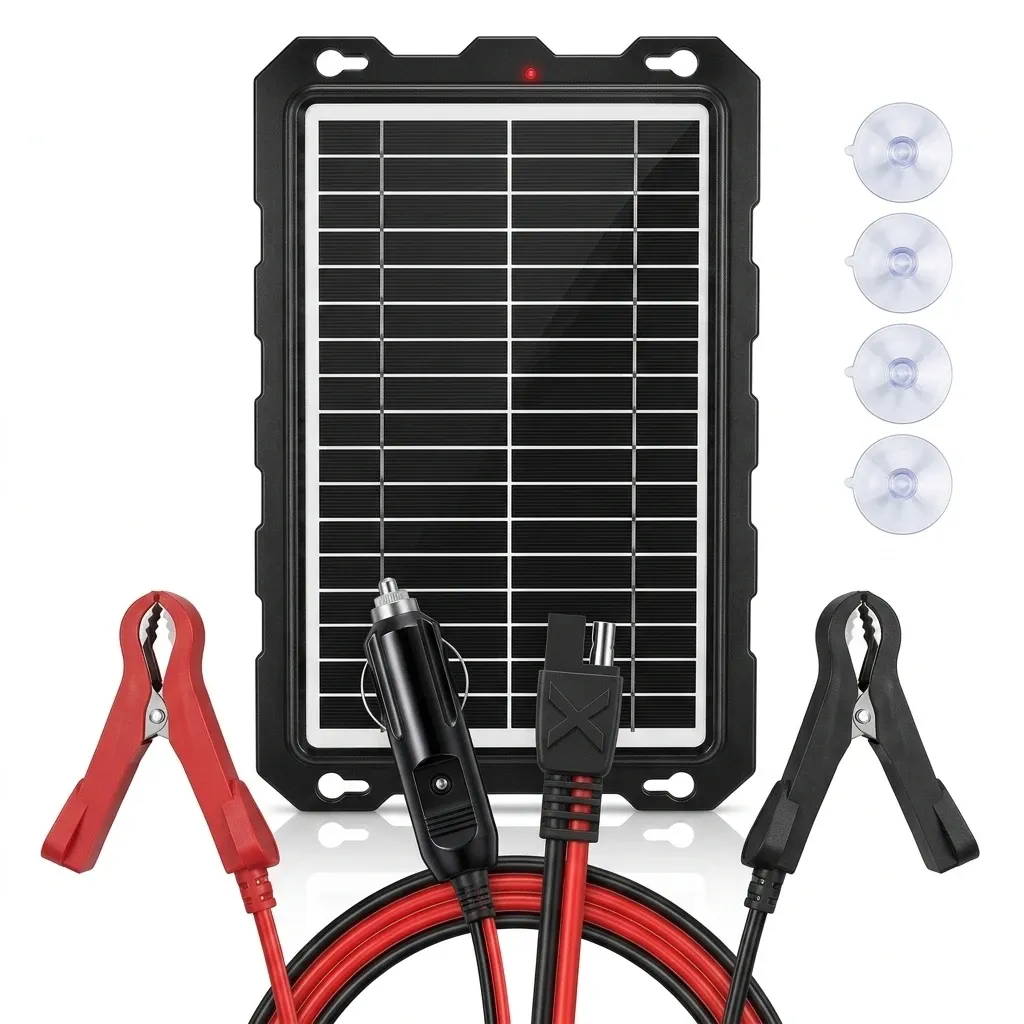
SolarBatte describes the POWOXI product as an “8W POWOXI panel for a 12V battery” and markets it for maintenance without mains access. This identifies the advertised rating and purpose; it does not establish a daily winter charging total for your installation.
OptiMate’s instructions for its own solar systems say to choose a panel that can overcome the vehicle circuitry’s parasitic draw and return charge lost overnight. That is a useful maintenance objective, but those instructions do not establish POWOXI performance.
Use the process below to make a conditional purchase decision:
- Identify the battery, check its condition and starting charge, and confirm the permitted charging arrangement.
- Obtain a representative average parked-current measurement and calculate daily electrical demand.
- Compare that demand with quantified battery-side solar input, keeping the measurement boundaries clear.
- Monitor the battery through the conditions you need the installation to handle, including poor-light periods.
- Reassess the charging approach if a deficit persists.
Maintaining an adequately charged battery and recovering an already discharged battery are separate buying decisions. Plan this assessment around maintenance. If the battery is discharged or the car repeatedly fails to start, arrange battery and charging-system assessment and an appropriate recharge plan first. Do not buy the small maintainer on the assumption that it will quickly restore a flat battery.
This guide provides a calculation worksheet and a proposed observation process. It does not report a POWOXI winter test or establish that every outdoor parked car will pass or fail.
Check your battery and parking position before buying
Start with the exact battery and the place where the panel will actually sit. Use this proposed checklist to gather the information needed for a supplier enquiry and a monitored trial.
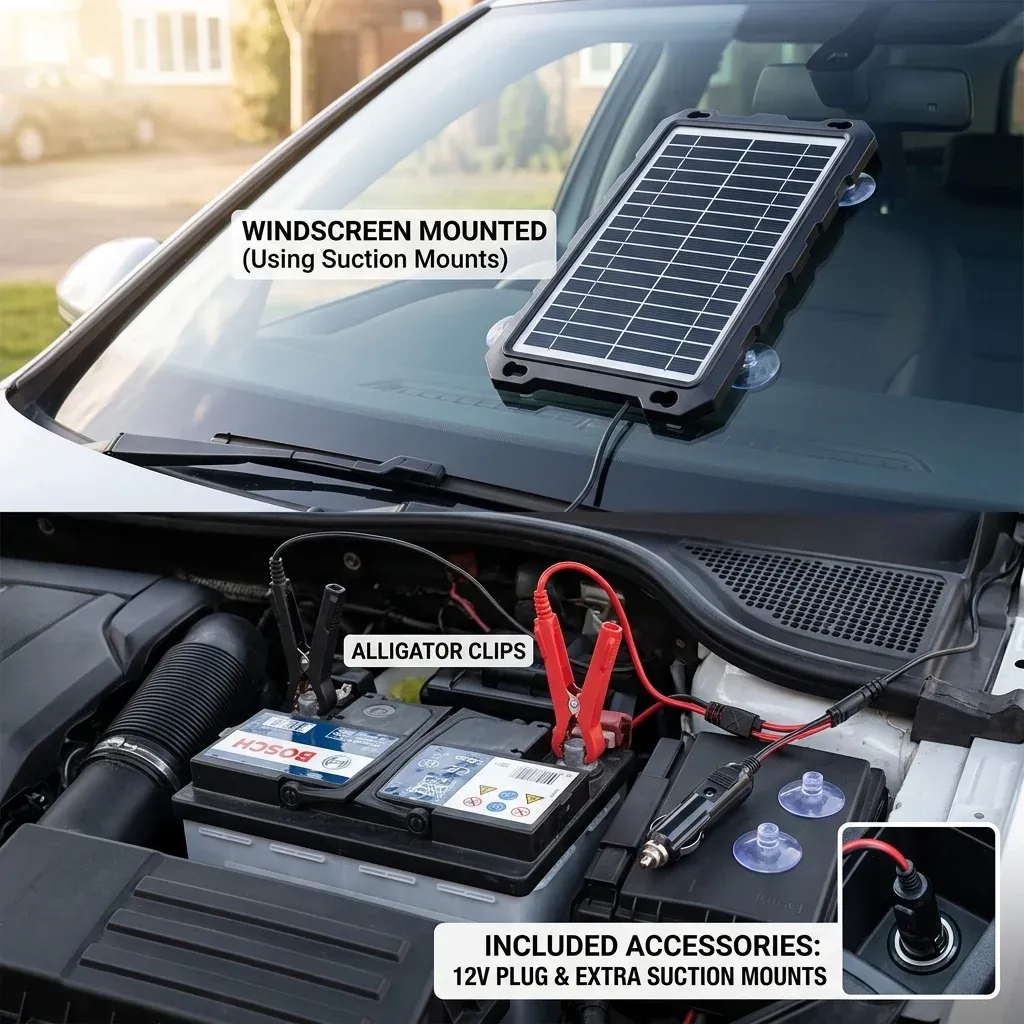
SolarBatte’s visible description specifies an 8W panel for a 12V battery. It does not, by itself, establish supported battery chemistries, capacity limits or compatibility with your vehicle.
| Battery and vehicle check | What to record or confirm |
|---|---|
| Battery identity | Make, model and the particular battery you intend to maintain; photograph its label. |
| Chemistry and capacity | The stated battery type and Ah capacity. Check both against the exact maintainer documentation. |
| Condition | Recent assessment, starting problems and unexplained discharge. Arrange an assessment if condition is uncertain. |
| Initial charge | Establish the starting charge using the battery or vehicle maker’s guidance. Obtain an appropriate recharge first if needed. |
| Vehicle requirements | The handbook’s storage-charging instructions, approved charging points and any required settings. |
| Maintainer requirements | Supported battery types and capacities, charging and maintenance limits, temperature limits and permitted placement. |
Pico Automotive recommends evaluating the battery and starting and charging systems before investigating parasitic current draw. If the car has a history of non-starts, ask a competent technician to follow that diagnostic order before using a solar trial to assess the shortfall.
Keep connection choice as a fit check here. Confirm the permitted socket or charging point from the vehicle handbook and exact maintainer instructions; this article does not provide a connection procedure. If uncertain, send the supplier the battery-label photograph, vehicle details and relevant handbook wording.
For the parking survey, use the space and direction in which the car normally stands:
| Exposure check | Proposed record |
|---|---|
| Position and orientation | Car direction, proposed panel location, facing direction and tilt; take a reference photograph. |
| Obstructions | Buildings, walls, trees, fences, other vehicles and any cover over the car. |
| Changing shade | Dated observations in the morning, around midday and later in the afternoon; note when shadows cross the proposed panel position. |
| Windscreen arrangement | Whether the panel will be behind glass, its exact position and any visible tint, coating or shaded area. Confirm permitted placement. |
| Practical fit | Available panel space and the proposed cable route to the approved connection point. Confirm panel dimensions and usable cable length before ordering. |
Repeat the observations when the parking position or installation changes. Use the record when requesting output evidence: ask whether the evidence represents your proposed arrangement, rather than assuming it does.
The POWOXI 8W product listing is a starting point for that enquiry. Leave unresolved compatibility details marked as unknown until confirmed.
Turn parked current into a daily charge requirement
Daily vehicle-electrical demand (Ah/day) = representative average parked current (mA) × 24 ÷ 1,000. Dividing by 1,000 converts milliamps to amps; multiplying amps by hours gives amp-hours.
The calculation is straightforward. Obtaining a representative average requires more care.
Pico Automotive’s parasitic-drain guidance explains that vehicle computers continue tasks after the driver has exited and locked the vehicle. It warns that pulling a door handle or operating the tailgate release while the vehicle is locked can wake a network and start another shutdown period. A reading taken during that activity should not be assumed to represent the whole parked day.
Pico describes parasitic-drain diagnosis as an extended test and describes using a current clamp to monitor shutdown into sleep mode. Its guidance also discusses measurement noise and averaging low current values. For this worksheet, ask a competent automotive technician for a representative average under your normal storage conditions, together with the observation period and any interruptions or recurring activity.
Do not substitute the lowest sleeping value or highest brief spike for the average. Pico notes that the rapid security-LED or keyless-entry pulses it describes contribute negligibly when averaged; that does not establish that every recurring load is negligible.
The following are hypothetical teaching inputs, not typical vehicle values, diagnostic limits or POWOXI measurements. Each assumes the average represents the full 24-hour parked period.
| Hypothetical average | Calculation | Daily electrical demand |
|---|---|---|
| 20mA | 20 × 24 ÷ 1,000 | 0.48Ah/day |
| 30mA | 30 × 24 ÷ 1,000 | 0.72Ah/day |
| 50mA | 50 × 24 ÷ 1,000 | 1.20Ah/day |
For example, 30mA is 0.030A, and 0.030A × 24h = 0.72Ah. This calculates vehicle-electrical demand under the stated assumption; it does not predict solar input or battery condition.
Use this proposed worksheet for your own result:
| Field | Your record |
|---|---|
| Vehicle and battery | Exact vehicle and battery assessed |
| Normal storage arrangement | Locking, alarm, connected accessories and key location |
| Observation conditions | Date, temperature if available, location, start and finish times |
| Measurement | Instrument, technician, shutdown behaviour and method used to obtain the average |
| Interruptions and recurring activity | Access, unlocking, wake events and recorded pulses |
| Representative average | Current in mA, stating whether it covers settled sleep or a wider parked period |
| Calculated demand | Average mA × 24 ÷ 1,000 = Ah/day |
| Limitations | Activity or conditions the observation did not capture |
If the measurement covers only settled sleep, label the calculation as a sleep-current estimate. If you have no representative measurement, leave your own demand unknown and use the examples only to understand the arithmetic.
Compare daily demand with usable solar input
Compare demand and solar contribution over matching periods, using battery-side measurements with clearly stated boundaries. Do not enter the advertised 8W rating in an Ah/day column.
OptiMate’s guidance for its own solar systems calls for sufficient current to overcome vehicle-circuit demand and return charge lost overnight. Use that as the maintenance objective without assigning its products’ specifications to POWOXI.
For this proposed worksheet, request a record of solar charge delivered towards the battery, after the controller, separately from vehicle demand. Ask the person taking the measurements to state whether the instrument records the separate solar contribution or the net current into or out of the battery. If it already records the net result with vehicle loads operating, do not subtract those loads again.
Keep panel-side energy in watt-hours (Wh) separate from battery-side charge in amp-hours (Ah). A panel-energy estimate alone is not a completed battery-side charge budget. Request the conversion assumptions, controller and charging-loss allowances, and measurement conditions before using an estimate. No quantified loss allowance is established here for this POWOXI setup; do not insert an invented efficiency percentage or assume that all delivered charge becomes stored charge.
The following hypothetical example demonstrates bookkeeping only. These are invented inputs, not POWOXI output, typical vehicle demand or a winter forecast. Assume separate measurements cover the same 24 hours.
| Entry | Hypothetical value |
|---|---|
| Vehicle-electrical demand | 0.72Ah |
| Solar charge delivered towards the battery | 0.50Ah |
| Solar contribution minus vehicle demand | 0.50 − 0.72 = −0.22Ah |
Under those assumptions, the recorded solar contribution falls 0.22Ah short of vehicle-electrical demand. This does not calculate the change in stored battery charge or quantify unmeasured battery losses. If solar input is unknown, the balance remains unresolved.
Use this proposed comparison record:
| Field | What to enter |
|---|---|
| Period | Matching start and finish times |
| Vehicle demand | Measured or calculated Ah, with conditions and limitations |
| Solar contribution | Battery-side Ah; identify separate solar input or an already-net battery reading |
| Comparison | Subtract demand only when it has not already been included in the reading |
| Installation | Panel position, orientation, shade and whether behind the windscreen |
| Conditions | Weather, parking changes and other charging sources |
| Uncertainty | Instrument limitations, missing periods and unquantified losses |
For its own STFP008 fold-up maintainer, Solar Technology states that positioning behind glass or perspex reduces power delivery. This provides no POWOXI windscreen-loss percentage. Assess the intended installation rather than applying a fixed deduction borrowed from another product.
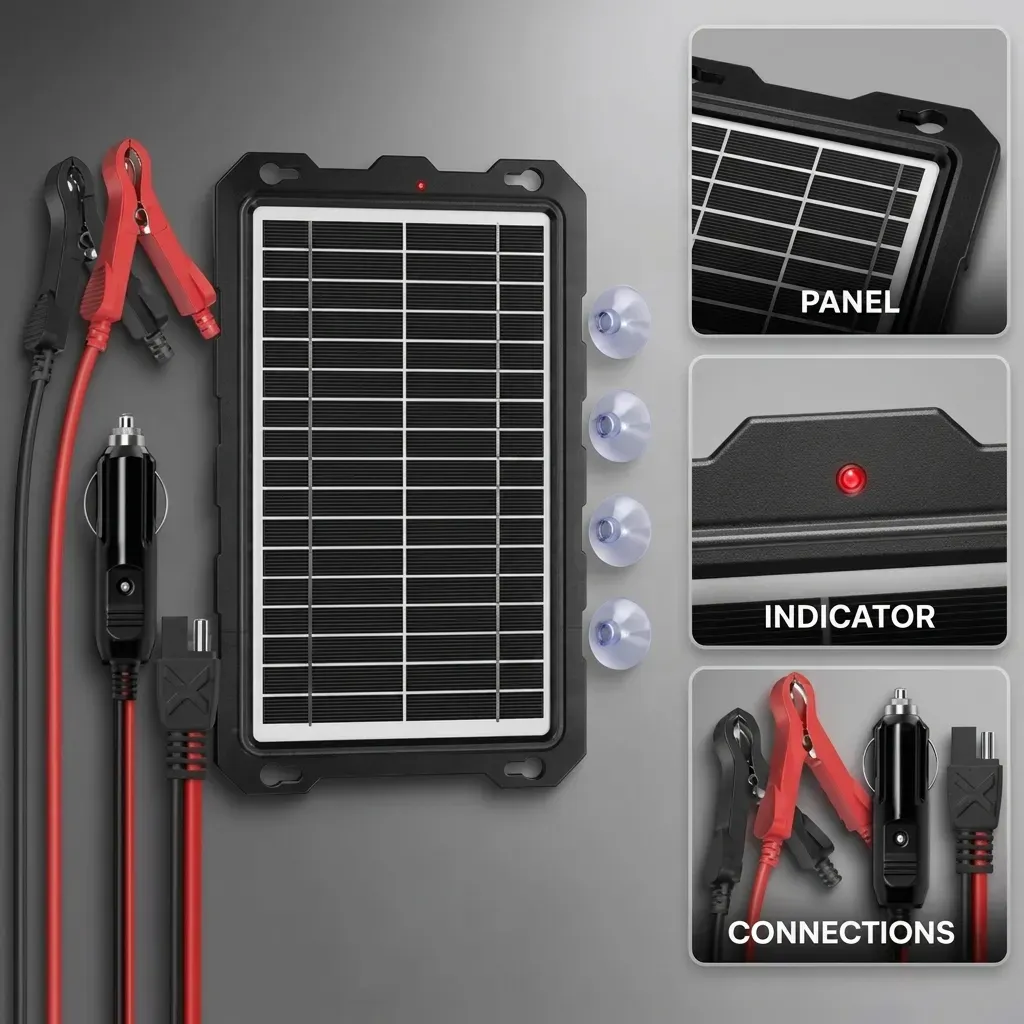
SolarBatte describes its lamp as red when there is enough sun and green when the battery is connected and charging. That description supplies no quantitative daily charging total. Record the lamp separately from the charge-budget figures.
Treat a measured shortfall as a reason to reassess. If input exceeds vehicle demand, continue checking the battery trend: a favourable arithmetic balance is evidence for the observed conditions, not proof of whole-winter adequacy.
Daylight hours are not full-power charging hours
Do not multiply the hours between sunrise and sunset by 8W and treat the result as your daily charging allowance. A daylight window does not establish constant output or charge delivered at the battery.
The Met Office says its climatological sunshine-duration measurements refer to “bright” sunshine. It reports that mean daily sunshine is lowest in December, with day length, wind and cloud contributing to seasonal variation. Those observations provide British winter context; they do not predict this panel’s output at your parking space.
To understand the distinction between clock hours and an output-equivalent duration, consider this hypothetical arithmetic exercise, not a technical definition or a forecast. Suppose an imaginary panel delivers a constant 8W for two hours and zero for the rest of the day. Its energy output is 8W × 2h = 16Wh. Dividing that hypothetical energy by 8W gives two hours at the chosen comparison output, regardless of how long the daylight window lasts.
This explains the calculation idea behind expressing energy as an equivalent duration. It does not establish the formal technical definition of “equivalent full-sun hours”, the conditions behind the POWOXI rating, or a local value you can use. Do not turn a daylight count or bright-sunshine record into a full-sun-hours allowance without documented technical guidance. For the purchase worksheet, keep daily input unknown until supported by a relevant estimate or measurement.
Use this proposed exposure record to assess how well any estimate matches your setup:
| Factor | What to check |
|---|---|
| Locality and season | Does the estimate represent your actual location and winter dates? |
| Weather | Does your trial include poor-light observations as well as favourable days? |
| Orientation and tilt | Are the assumed direction and angle the ones you can actually use? |
| Shade | Have you recorded obstructions and shadows at different times? |
| Windscreen | Does the evidence represent placement behind glass, if that is your plan? |
Solar Technology’s instructions for its STFP008 recommend south-facing placement at 35–65 degrees where possible and say that behind-glass or north-facing placement reduces power delivery. Those are instructions for that model, not a POWOXI mounting prescription or loss factor.
SolarBatte describes four suction cups for holding its panel on glass. That mounting description does not supply a winter yield behind your windscreen. Keep exposure observations, panel-energy estimates and battery-side charging measurements as separate entries, and accept no guaranteed charging duration from the rating alone.
Run a monitored trial in the actual parking position
Use a trial to assess the recorded installation and conditions. Interpret the battery trend using guidance for your exact battery or vehicle, and keep indicator observations separate from quantified charging evidence. The following is a proposed observation method, not a validated winter test.
Before starting, obtain the maker’s instructions for assessing charge and deciding when to recharge or seek assistance. No battery-specific thresholds are established here. Do not convert a single voltage reading into a universal charge percentage or adopt a universal cut-off.
If battery condition is uncertain, arrange an assessment first. Pico Automotive places battery and starting/charging-system evaluation before investigation of parasitic current draw.
Use this proposed log for each observation:
| Entry | What to record |
|---|---|
| Baseline | Battery make, model, chemistry and capacity; assessed condition and initial charge; assessment method and date |
| Observation method | Instrument, units, time and the manufacturer’s guidance used to interpret the result |
| Measurement conditions | Temperature if available, recent driving or charging, time since either and vehicle access or electrical use |
| Parking position | Location, direction, nearby obstructions and whether the car moved |
| Panel arrangement | Position, orientation, glass placement and changing shade; reference photograph |
| Weather | Observed cloud, sunshine and poor-light periods |
| Charging evidence | Battery-side charging total and its period, if available; otherwise record it as unknown |
| Indicator | Colour and observation time, separately from the charging total |
| Battery trend and action | Assessment, comparison with baseline, interpretation and any recharge or installation change |
Record every drive, separate recharge and configuration change. For this trial, do not credit the panel alone with maintaining the battery over an interval that included another charging source. Label observations after a placement change as a new configuration.
SolarBatte says its lamp shows red when there is enough sun and green when the battery is connected and charging. That description provides no daily Ah total or battery-condition assessment.
Include poor-light periods rather than ending the trial after favourable weather. Set review points using the applicable maker’s guidance and observed trend; do not wait for a starting failure before acting.
| Trial evidence | Proposed response |
|---|---|
| Comparable observations show a satisfactory battery trend under the maker’s guidance, including poor-light periods | Continue with ongoing checks; limit the conclusion to conditions observed. |
| Only the lamp has been observed, or battery readings cannot be interpreted | Keep sufficiency undecided; obtain appropriate assessment and quantified charging evidence where practical. |
| Exposure is obstructed and the battery trend is unsatisfactory | Review permitted placement, change one aspect at a time and repeat observations. |
| A persistent deficit is measured or assessed charge continues to decline | Reassess demand and condition, and evaluate another charging approach. |
| The maker’s guidance calls for recharge or assessment | Act on that guidance before continuing. |
Do not choose an arbitrary trial length as proof of whole-winter reliability. Reassess after changes in exposure, parking arrangement or battery trend.
Choose the charging approach that meets the measured shortfall
Continue monitoring when the evidence supports the installation, investigate uncertainty, and assess alternatives when a deficit persists. Use this proposed decision table alongside the budget and trial log.
| What the evidence shows | Suggested next step | What remains to establish |
|---|---|---|
| Battery-side input covers measured vehicle demand and the battery trend is satisfactory under the maker’s guidance | Continue checks in the same configuration, including poor-light periods. | Repeatability and performance beyond the conditions already observed |
| Input is unknown, readings conflict or only the indicator has been observed | Keep sufficiency unconfirmed; review measurement and placement. | Quantified charging input and an interpretable battery trend |
| A deficit persists after battery condition and parked demand have been assessed | Assess a larger regulated solar system, or a compatible mains maintainer where power is available. | Suitability for the exact battery, storage conditions and measured shortfall |
| Repeated discharge or starting problems remain unexplained | Arrange professional battery and vehicle diagnosis before buying more charging capacity. | Battery condition, starting/charging-system operation and relevant parked-current behaviour |
For a larger solar system, take the supplier your demand worksheet, parking photographs and trial log. Ask for the proposed panel and controller to be assessed together against the battery requirements and actual winter exposure. OptiMate’s supplied manual describes panel-and-charge-controller systems, but it does not establish a replacement size for your car. No replacement wattage or recovery time is established here.
For mains maintenance, shortlist equipment with documented support for the battery and intended installation. CTEK describes float/pulse maintenance for long-term connection on its MXS 5.0, and its technical data identifies that model as a lead-acid charger. This is an example of documented maintenance provision, not confirmation that it suits your battery or outdoor winter location. Check the exact alternative’s capacity, temperature and installation limits.
Victron’s Skylla-IP65 instructions state that the charging algorithm must fit the connected battery type. Apply that compatibility check when assessing alternatives; do not transfer its charging settings to POWOXI.
If diagnosis is needed, Pico Automotive recommends evaluating the battery and starting/charging systems before investigating parasitic current draw, which it describes as requiring an extended test. Ask for the cause of the loss to be assessed, rather than assuming a larger panel will resolve it.
Before buying, confirm that you have:
- Identified the battery, chemistry, capacity, condition and starting charge.
- Checked the vehicle’s permitted charging arrangement and exact maintainer compatibility.
- Recorded representative parked demand, or clearly retained it as unknown.
- Assessed actual winter exposure and the evidence behind any solar-input estimate.
- Chosen a monitoring method and a fallback if charge declines.
SolarBatte lists the POWOXI solar battery maintainer as an 8W panel for a 12V battery. Consider it subject to these checks. Buy on the basis of a documented fit and a credible plan to assess the charge balance; leave winter sufficiency unconfirmed until the evidence supports your installation.